
By Madelyn Ostendorf
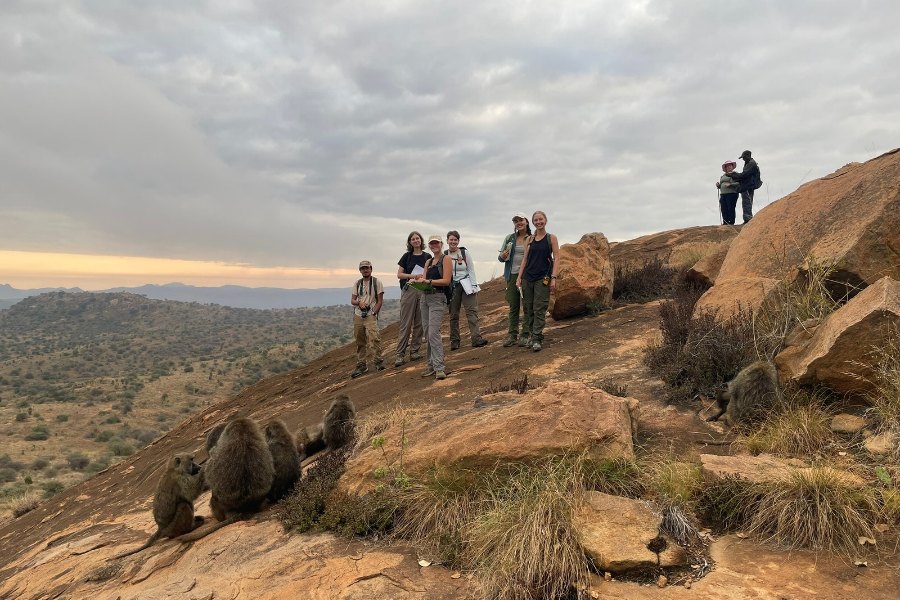
When Corinna Most first traveled to an olive baboon research site in Kenya, she wasn't immediately convinced she had found her future.
The hiking was difficult. The heat was intense. And the dozens of baboons she was learning to study all looked the same.
"It was really overwhelming at the beginning," Most said. "But then something clicked. I could tell the small differences between the baboons, and once I could recognize them individually, I was able to really understand what was happening."
Today, Most is an adjunct associate professor in the Department of Ecology, Evolution and Organismal Biology where she researches how young baboons learn to navigate the social dynamics within a troop (a group of baboons). She also serves as co-director of the Uaso Ngiro Baboon Project in Kenya, one of the world's longest-running baboon research programs.
Most's interest was never specifically about primates. As a student, she was fascinated by animal behavior and wanted to understand why individuals act differently from one another. While exploring courses in zoology and psychology as an undergraduate at University College London, she discovered primate behavior and realized it offered a unique way to study complex social relationships.
"I didn't grow up thinking monkeys were my favorite animal or wanting to study monkeys," Most said. "I was really interested in behavioral variation and social behavior."
That curiosity eventually led her to the Uaso Ngiro Baboon Project during her graduate studies at the University of California San Diego. Founded in 1984 by Shirley Strum, the project follows wild baboons living in large social groups and has generated decades of behavioral and ecological data.
What keeps Most engaged is the complexity of baboon society. Once researchers learn to identify individual animals, they begin to see family ties, friendships, rivalries and alliances that shape daily life within the troop.
"It just becomes like a soap opera that you're getting to witness, but between wild animals," Most said.
Through her research, she has described how infant baboons interact with friends and relatives, establish new relationships, and navigate the group’s social structure.
She is equally passionate about helping students gain hands-on experience. At Iowa State, undergraduates help digitize decades of data and analyze behavioral patterns, as well as conduct observations on the animals housed at Blank Park Zoo. Some students have also traveled to Kenya to participate in field research, in part thanks to an NSF grant that Most received to support international research experiences for students.
The experience often gives students a clearer picture of their future careers.
"You don't know what fieldwork is going to be like until you do it," Most said. "You have to really be into the research."
Some students return from Kenya inspired to pursue graduate school and research. Others discover a different path better fits their interests. Most considers both outcomes a success.
For her, the goal is simple: give students an opportunity to experience the realities of field research while contributing to a project that has been documenting baboon life for more than 40 years.